Monday, July 18, 2016

Mapping

Yesterday I attended a permaculture gardening workshop at the Chapel of Sacred Mirrors in Wappingers Falls, NY.  It was facilitated by Delvin Solkinson and Grace.  It was an inspiring afternoon.  While I was familiar with many things that were discussed, it was helpful to hear it from another inspired perspective.  And it was great to connect with like-minded people.

One thing we've talked about is mapping.  I've done some mapping already, but there is much more to do.  When we bought the house almost a year ago now, we had to get a property survey done.  It was annoying to have to pay for it at the time, but it's actually really nice to have these maps now!  I'm using them for my designing ideas, first in designing our "dueling gardens" chicken coop location idea, as you may have seen in my previous post.

Although I'm trying to be patient and do more observing during this first year, I have added some elements.  (Hey, we will have been year hear in just nine days!)  So I needed to create an upgraded map of the design elements.  I included structural elements, some water sources (rain barrels, and outdoor spigots), some trees and shrubs, and perennials.  I want this map to serve as a base map that I can use for mapping other things.


Next I will do some sector mapping.   Sectors are essential directional influence maps.  So for example, creating a sun sector map by calculating sunrise and sunset locations in all seasons.  Or mapping prevailing wind patterns.  I've been observing wind, but to be honest, I have no clue where the hell the wind usually comes from here.  It seems to be everywhere.  Maybe it has to do with our proximity to Mount Beacon.  I'll be sure to share the sector maps with you soon.  


Thursday, July 14, 2016

Wildlife and Biodiversity.

I am out doing chores this morning and happened upon some nice wildlife, including a couple critters I haven't seen here before. I take it as a good sign, and I hope to see more new friends in the future.  

A little toad.  I pretty sure that chicken wanted to eat him.  But I set the toad down a little ways from the fence.  I'll let him choose his own fate.

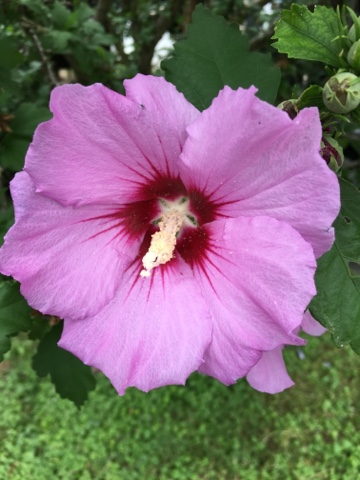
The hibiscus started flowering, and it's loaded with buds.  

Moments later I saw this honeybee leaving a hibiscus flower.   He was covered in pollen!  So much so that flying seemed a challenge.  Pollen butt.  Nice to see!

We used to call these lady bugs.  Then they told us in school that they're really called Ladybird Beetles.  But now I see they're called Asian Lady Beetles.  Maybe it's here because my wife is an Asian lady.  I think they're good in the garden.  They eat aphids.  Back in Brooklyn I actually bought a box of them to combat aphids.  I spread them out over and around the infested plants.  But apparently they preferred some other kind of lunch because they all left within minutes.  


Hooray for biodiversity.  Hopefully it's a sign that some of my efforts are creating good soil. The food chain starts in the soil with microbes.  A diverse population of microbes means more diversity up the food chain.  

An interesting parallel to note is the decrease of microbes in the soil that commercial commodity monoculture crops are grown in, with a decrease in diversity of our culture.  The soil in those monocultures is essentially dead.  It's just there to hold plants in place while the farmers feed it chemicals. These huge crops of corn and soy are used as building blocks for junk food, fast food, chain restaurant food.  It's why you get the same exact meal at any TGI Fridays across the country.  (How sad and kind of disgusting, right?)

Could it be that a population fed from monocultures starts to become a monoculture itself?  Go to nearly any city in the USA and you know what you're going to find there: A Walmart, a Home Depot, a Starbucks, and all the same chain and fast food restaurants.  

BUT, happily it does seem to be changing for the better.  There is a really strong artisan movement building, don't you think?  People making highly specialized food, drinks, and goods right here in America.  You can find that stuff.  You pay a little more for it.  But the quality and craftsmanship is awesome.  Perhaps it's not just a coincidence that the artisan movement is happening along side the rise of organic, small-scale, microbe-friendly food production.  That notion excites me.  

I've been reading a book called Will Bonsall's Guide to Radical Self-Sustaining Gardening.   It's pretty over my head honestly.  But through seed saving, Mr. Bonsall is preserving, developing, growing, and eating al sorts of rare varieties of foods - veggies, fruits, and grains.  It's really amazing to me to think about the healthy biodiversity he must be creating in himself and his family.  He's got all these unique varieties and strains of foods developed right there in the biome of his property.  This food is intimately connected to his immediate environment.  When he and his family eat it, they are themselves becoming biologically intimate with nature around them.  Plus they've got so many varieties that you and I will never find at a store of even at farmers markets.  They've gotta be the strongest people in the country!  He's obviously on a serious mission, going way beyond most peoples' capabilities, but gardening and seed saving were things that nearly everyone did at one time.  That, and more active lifestyles, among other things, are factors that I believe made our ancestors stronger, happier, more disease resistant.  Doesn't it kind of seem like we're all a bunch of weak complaining pussies these days?  I think we gotta get our soil diversity up - with our own hands.  Then grow some food in that soil - with our own hands.   Then cook it - with our own (dirty) hands.  Then eat it.   

Here's to diversity!  

Ooo!  I just saw one of those black and yellow butterflies checking out the cone flowers.  A Tiger Swallowtail maybe? Nice. 
  

Tuesday, July 12, 2016

Habitats and Hens

Hello friends.  It's been awhile since I've done a post here aside from that little article I linked to yesterday.  While I have some exciting developments to report, the truth is that I've felt a bit overwhelmed, embarrassed, and depressed about how my gardening efforts are going.  I spent a week in Minnesota at the end of June visiting family.  My parents and my siblings are extraordinary gardeners.   Their gardens were very inspiring, but also very humbling.   Their plants were much further along than mine, as so are the gardens of my friends in Beacon.   Here I've been studying so hard, working hard, and blogging - hoping that I'll  inspire people with what I'm doing.  But my plants are so behind.  How embarrassing.   

There are some reasons why my stuff is behind, and I find them encouraging.  1.) I haven't even been here a year yet.  I'm still learning the patterns here, as I will be for years to come.  2.) The sheet mulch beds that I've done are supposed to take some time to get good.  Plus I made the mistake of using whole leaves as my main organic material.  If I had shredded the leaves, I think I'd be seeing better results.  I won't forget  that next time.  3.) I've been filling my head with a ton a new information.  Things will take time to sink in.  I'm aware of a pattern of mine:  I study theory and concepts like crazy and end up with inflated ideas that might not be the most realistic.  I've done this in music, in yoga, in eating, and I'm finally learning from that tendency.   Seeing my families' gardens and learning from them was a great lesson in practicality, and the real world.  

I'm trying to remember that this blog is not an expert advice column, as I stated in the beginning.  I'm just figuring it out and learning as I go, and I'm sharing that experience with you.  

I didn't take many photos in MN, but here's one of my parents front yard.  The place is popping!  

Now onto the developments!  We've been doing some habitat creation here, starting with human habitat.  We needed outdoor eating habitat, so we built a classic picnic table!  We've been eating most every meal at it since its completion.   

Akiko sanding.  

Akiko's paint job.  We painted it before assembly to protect the wood at the joints.  

Assembly

The finished product!

We also built some Adirondack chairs.  In desiring some good outdoor hanging habitat, we were on the lookout for some chairs.  You see these plastic Adirondack chairs all over.  They're cheap, and tempting.  Wooden ones are harder to come by and expensive, so I thought I'd try building some.  I'm very happy with how they turned out.   I've been sitting in these chairs playing banjo, and I'm sitting in one right now writing this very post.  

Akiko painting the first chair

Akiko and Minnie trying them out.  We went with subtle colors as you can see.  

Learning to play my new birthday present in a homemade chair.  Not too bad.  

Picnic table and chairs are essential to the design of the property.  I have all sorts of big ideas about all pollinator habitats, fruit trees, annual vegetables, solar panels, and everything that we're going to have here in the future.  But it's important not to design ourselves out of the picture.  Some lawn space and hangout banjo space is important.  

The other major habitat I've been working on is for chickens.  Our friends Sara and Justin bought a house in Beacon in December.  Their house had a coop in the back yard.  They didn't want to raise chickens, so they offered it to us.  I disassembled it in April, moved it with the help of a neighbor, and it sat in the garage for a couple months.  What prevented me from erecting the coop right away was location consideration.  I had a few ideas:

My first instinct.  Coop is under a maple, but farther from the backdoor and really far from the vegetable patch.  

Coop is closer to the vegetable patches, and partially shaded. 

Similar to number 2, except oriented in a different direction.  

Farther away from the house, close to the empty lot next door (which probably won't be empty forever)

Finally I settled on number 3.  The idea is to give the chickens some shade, have the egg boxes fairly close to the back door, and have the hens in proximity to two annual vegetable patches.  The concept is called “Dueling Gardens”.  I read about it in a book by Harvey Ussery called “The Small Scale Poultry Flock”.  The idea is that you alternate planting between the two patches, and the chickens forage on the one that isn’t planted.  I really love this idea.  The chickens eat bugs, weed seeds, and leftover veggies.  They stir it up, add their manure, and are happy as can be.    It also gives the soil a period of rest and rejuvenation every other year.  It seems like a win win situation.  Another benefit of location #3 is the potential to collect some tree fall through off of the coop roof.  Rain that falls through a tree hasn't been studied much.  But apparently, the rain picks up all sorts of minerals and all sorts of other goodies as it falls through the tree.  It might be a good fertilizer to water with.  I plan to get a gutter and a rain barrel for the coop eventually  

I managed to put her back together!

I had so many scratches all over myself from that hardware cloth.  The design on the end is of two sliding doors.  One will lead to one veggie patch, and one to the other.  I rigged them with ropes and latches.  

I built the roosts out of some branches I trimmed off the maple to make room for the coop.  They use them.  

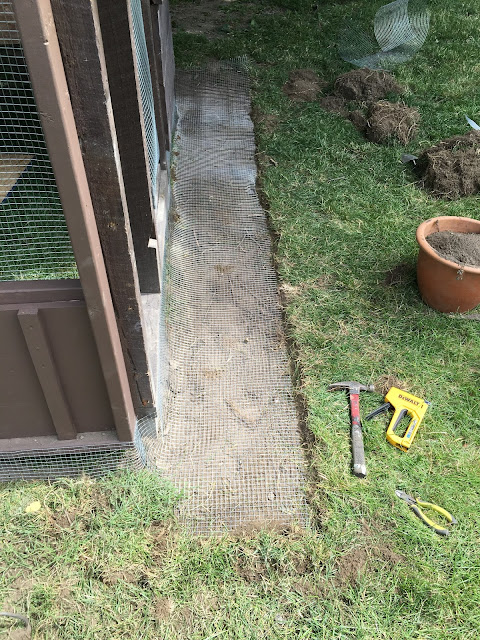
Predator proofing.  This wasn't the easiest job.  
I was able to go a foot down on this end because it was farthest from the tree.  

Around the rest I had to go flat against the ground because of all the tree roots.  

I put the sod back on top, although most of it didn't survive.  

By the time I had the coop reoriented, erected, and secured with 1/2 inch hardware cloth it was mid June, just days before my aforementioned trip to MN.  So I waited until I got back to seek out some hens.  Plus we had to the get the coop inspected by the city of Beacon, and I wanted to do that before getting the birds, so that I could make any necessary modifications with ease,  Happily, we passed the inspection without any problems.  

Via a post on the Beacon Hen Keepers Association Facebook page, I got connected with someone who was selling some Speckled Sussex hens that just started laying eggs.  Perfect!  I picked them up on the evening of June 30, and just like that we were chicken keepers!  

They were pretty afraid of me the first couple days.  But they’ve warmed up quite a bit to me, especially because I’m tossing them watermelon rinds every day (I love summer!).  They go nuts for them.  I spend the first few days fencing in the run, which will be the second vegetable patch.  I managed to get it up after a few days, and boy were they happy to get out and stretch and eat wild stuff.  Later I moved the strawberry patch and some perennial flowers out of the run so they wouldn’t get eaten.  The chickens immediately scattered the mulch that I had around those flowers.  They love some bare dirt for dust bathing.  

Their first night in their new home.  Pretty freaked out, as you can imagine.  

 Minnie and the hens are getting used to one another.  

The run / future annual garden bed fenced in.  

Hens in the run.  Digging up that mulch, finding stuff to eat.  


One permaculture concept is the idea of “stacking functions”.  That means seeing the multiple functions and benefits of a particular design element, and placing it so to maximize those benefits.  So here are some of the benefits of having a backyard flock of hens:

1.) Manure.  The person I bought the hens from said each one produces three cubic feet of manure a year.  Now that is a lot of shit.  This, if managed properly, is great for the soil.  I'm attempting a deep litter method of manure management.  Basically I add a lot of carbon rich material to the coop floor and eventually to the run.  As the chickens shit in it, I add more carbon material little by little and and eventually it becomes a nice compost to use on the garden.  The original vegetable patch has deep mulch on it already.  For the new patch, I'll let them work on the grass.  If it starts getting stinky in there I'll start adding some carbon material.  But I'll plan on sheet mulching the new bed (I think I'll do a better job) after harvesting everything we can out of the original patch and moving the hens onto it.  

2.) Weed eating.  Speaks for itself.

3.) Bug eating.  Chickens are supposed to eat a lot of harmful insects, including tics.  I’ve really enjoyed watching them chase the occasional flying insect.  

4.) Tilling.  Chickens are used to create new planting spaces.  Put them on a small patch of land, and they’ll scratch it all up, removing the vegetation, fluffing up the soil and adding some manure in the process.  

5.) Composting.  Chickens can speed up a pile by mixing it up for you, and eating kitchen scraps and turning them into manure.  Just today I came across some leaves a neighbor had set out by the curb.  Finally some brown material!  So I built a pile in the run inside a cardboard box without a bottom.  I’ll remove the box after the materials have broken down a bit.  If I didn’t have a box, it would probably still work, but I thought the chickens would spread it all out before it broke down.  Maybe they’ll just peck through the box too.  We’ll see.  

6.) Eggs.  Many hen keepers are only thinking of fresh eggs.  But the eggs are more of a bonus for us.  I’m thinking about all the above benefits before the eggs.  However, I’ve been enjoying them for sure, as have been many of my friends.  Eating eggs from your backyard is a good way of connecting to the local ecosystem.  The chickens are taking things that I don’t want to eat and don’t digest so well: worms, insects, weeds and their seeds, grass, etcetera, and converting them into a highly energy dense, nutritious, and delicious thing that I do enjoy eating.  I’m connecting to, and benefitting from, the existence of all those worms, insects, etcetera, in a way that I wasn’t before.  

7.) Warning.  If there’s an animal that wants to eat my garden veggies or the hens themselves, they will probably start squawking when it shows up.  I haven’t experienced this, but it’s something I’ve read about.  We’ll see.  They do get noisy if Minnie gets too interested in them, that's for sure!  

8.) Entertainment.  I’ve spent quite a lot of time just watching these hens do their thing in the run.  It’s fascinating.  Better than TV.  They pretty funny animals.  

Am I leaving anything out?  Can you think of any other functions of these chickens?  

There is a lot said about the environmental harm of eating animal foods.  However all of that is based on the industrial feed lot operation model.  Those are unquestionably the saddest, most polluting, most backward, sinful, awful, ridiculous systems ever.  Please do not buy that food.  Do not order it at restaurants.  Ever.  Please.  Those operations are the  opposite of a balanced ecosystem.  There the manure is pollution.  The shit that made our soils fertile is now polluting it!  How heartbreaking.  I could go on and on, but you get the picture.  Eating eggs out of your back yard is animal food intervention.  The two dozen eggs I've given away since my hens arrived are two dozen less that are potentially being purchased from an unbalanced, unethical food production operation.   

Now let's consider a natural balanced ecosystem.  You won't find a natural system in which manure is a pollution.  If you do, it's a temporary imbalance that will correct itself, unless it's human doings that caused the imbalance, in which case we might need to go in and fix it.   Harvey Ussery says, "Waste is not a concept that nature recognizes."  Everything is reused and recycled.  In nature, you won't find chickens crowded into a confined space with only two square feet of personal space each.   Can you imagine the damage they would do, and how they would starve?  In nature you find a population of birds that is supported by the available food, shelter, and predation.  Their population density is far from being a problem - it can't be until something, usually some kind of human related phenomenon, causes conditions for that population to explode.  We have done a lot of damage to the ecosystems of the earth.  If we were to suddenly disappear, some places would regenerate into a balanced ecosystem.  But some places would not.  In either place we can be a regenerating force right now.  With our daily habits and choices we can support natural, sustainable, regenerative systems.  We're trying to model our systems after nature, only tweaking them slightly one way or another for our benefit.  It's better that many of are here on this planet, because we need many of us to fix things.  Happily there is a growing movement of us, trying to do just that, which is very exciting.  

Got a little preachy there at the end.  Sorry.  I'm feeling better after writing this post.  I'm excited for what's to come in our yard and beyond.  Come on over and sit in some home made adirondack chairs and watch some happy hens work, and go home with some fresh eggs.  We have many to spare!  

Monday, July 11, 2016

Let it grow

Here's an interesting article that aligns with what I've been learning. 
 
Do we view ourselves as separate from nature?  All other life is here for our benefit?  Have we conquered it?  Manipulated it?  Modified it for our benefit at the expense of other plants and animals?

Or do we view ourselves as integrated members of an ecosystem?  

https://www.washingtonpost.com/posteverything/wp/2015/08/03/my-town-calls-my-lawn-a-nuisance-but-i-still-refuse-to-mow-it/#comments

Friday, June 10, 2016

Polyculture

I want to explain the polyculture beds I was talking about in my last post.   You may have heard of companion planting before.  This is a method of planting two or more species together to get more yield.  Often the plants provide beneficial functions to one another.  A classic example of this is called the Three Sisters.  Its a traditional Native American planting of corn, beans, and squash.  The corn stalk provides a trellis for the beans to climb, the beans fix nitrogen, and the squash  keeps the soil cool and might keep some predators out.   I was reading somewhere that there is additional biological symbiosis happening as well.  Plus the three sister provide a satisfying and nutritious meal.  I've created a three sisters garden, which seems to be doing great so far.  

My three sisters mound as of June 10:

The other thing to remember about companion planting is the reduced space.  I was watching a YouTube video with Will Bonsall recently in which he explained that as long as if your production of each companion (of a two companion planting) is at least 51% of what it would be planted alone, that you're then increasing production.  If you get just over half the yield of each, then you're getting more in total on a given plot of land.  Often one crop is either increased, or at least not decreased, while the other produces say 75% of what it would alone.  In that case you're getting 175% out of that plot.  

Polyculture is similar to this, but not exactly the same.  First let me explain what I did, then I'll explain some of the ideas behind it.  I fairly closely followed the Ianto's Advanced Polyculture instructions in Gaia's Garden by Toby Hemenway.  Essentially I densely sowed a whole bunch of greens and radishes to act as an edible ground cover.  Included were a few different mustard greens, red radishes, daikon, horseradish, arugula, lettuces, onions, carrots.  A week later I added fava beans.  

Things sprouted pretty quickly, but were a little slow to grow at first.  I was also tweaking my irrigation system at the beginning.   I have some soaker hoses, but I have the garden system hooked up to a well pump in the basement that doesn't quite give the pressure that municipal water does. So I've poked some holes in the hoses and created more of a sprinkler hose system.  It's great to be using that well water instead of municipal water to wash the car and water the garden when needed.  

As I acquired starter plants of cabbages, cauliflower, kale, etc, I added them in spaces that were left over from my messy sowing job (or places where things just didn't sprout well).  Just last week I stuck some cowpeas and bush green beans in there too.  

Some of the ideas behind polyculture sowing are: 

Imitation of nature - plants don't grow in perfect little evenly spaced, sun-drenched rows in the forest.   They're either very close to one another in healthy competition, or are shaded out by trees.  Planting densely leaves little space for weeds to grow.  Like companion planting, we're getting a lot more yield in the sum of our crops, even though the yield of one particular plant species is probably a little less.  

Many different species are growing right next to one another in the forest.  This confuses pests - the opposite of an "all one kind of bug can eat" monoculture.   

Succession:  Red radishes might shoot up fast and shade out some other young plants. But as I pick them and eat them (I always harvest the whole plant in this method), the other species can then grow.  Also, in the holes of my harvesting, I put larger starter plants that will need more room.  Similar to a way succession works in a grassland becoming a forest.  I'm just helping it happen within one season. 

I'm not sure how much the symbiotic relationships are happening in a polyculture planting.  I'm sure there are some, but only long time observation along with sharing information will tell.  Probably there are many benefits, but probably some hindrances as well.  

This all makes sense to me.  But it is quite contrary to the "normal" row gardening that I'm accustomed to.  I had to wonder if it was going to work.   

So, the results of my first time trying a polyculture planting...  After a period of uncertain growth rates, things really took off.  Suddenly June rolled around and there is way more ofedible ground cover than we can eat!  We're having big salads every day and it doesn't seem like we're even making a dent.   I'll actually probably plant less next year - either less densely or less area.  

Plants are growing strong and tall despite their close proximity to one another.  A few species - broccoli rabe among them I think -  are flowering pretty quickly - a long stem, small leaves, and flowers.  I'm guessing that's happening because of the dense planting, but I've been able to catch them before they get bitter.  I usually pick the leaves and the flower to eat, and leave the stem on the surface of the bed.  I've found that the slugs eat these decaying stems before going to the living plants.   Other than that, I can't really say that things seem stunted because of being crowded.  As I un-crowd an area by picking the whole plants I'm going to eat, the remaining plants get their chance to grow up a bit.  

One interesting aspect of this, is that I can't tell what is what.  I go out there to pick a salad and I don't really know what I've got until I find out bite by bite.  It's kind of a fun adventure that way.  "Ooh! I got some Horseradish in that bite.  Wasabilicious!"  Of course I'm learning what is what by nibbling in the garden and then learning the look of the specific plants.  Since things aren't laid out in rows, it's almost like I'm foraging, except that I know everything is something delicious.  Sometimes when I'm out hunting slugs in the evening I'll come across a big red radish.  It becomes a fun challenge to see if I can relocate that radish just before lunch time the next day - often I can't! 

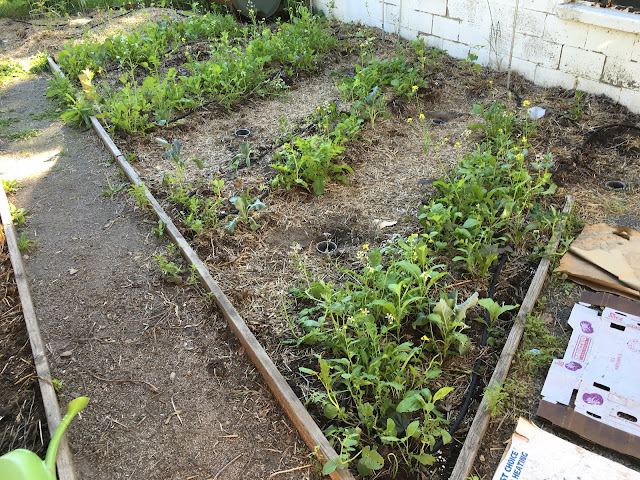
My polyculture beds as of June 10.  

A salad made from our edible ground cover.  Yummy surprises!

Overall I'm quite pleased with this polyculture planting, other than there being too much to eat.  Not a bad problem to have though.   It will be exciting to see the gradual transition to larger plants - brassicas, and bush beans, etc.  

Friday, June 3, 2016

Sheet Mulch Much?

Let me set the record straight.  Mulch and I never really got very far.  I don't know...I guess mulching was just not part of my basic understanding of gardening.  When I think about the gardening I was around as a kid, I don't remember much mulch.   I thought gardening was: you till the soil, you plant what you want to grow in rows, and you pull all the other shit out.  If I think really far back the only mulches I remember are a bark mulch around some shrubs in our front yard, and some kind of wood chips, maybe cedar mulch, around my Grandma Betty's Carver County Fair prize winning roses.   There was probably much more mulch back then, but for whatever reason the practice didn't follow me into adulthood.  

I didn't mulch much in Brooklyn.  I only put leaves on the garden beds some winters, but I cleared them and tossed them as soon as I planted in the Spring.  The soil remained bare during the growing season, aside from the veggies and flowers I planted. One time I mulched around the rose bushes with cedar.  But I didn't really keep it replenished in subsequent years.  

When I first started a veggie patch in Brooklyn, my landlord's gardener instructed me to use newspaper - to lay out sheets and water them and throw some leaves on top.  This was done in the Fall over a large area of the yard that had been used to grow veggies a few years ago and then had been covered with weeds. This was basic sheet mulching, although I didn't know it at the time. 

I went to the Brooklyn Botanic Garden and spoke with a gardening expert.  He instructed me to poke through the mulch to plant in the Spring.   But that just didn't compute to me.  "What do you mean?" I thought. "Where's the damn dirt?  You put plants in black dirt, not leaves!"  So in the Spring I pulled all the leaves off and threw them away.  The newspaper had decomposed.  

Fast forward six or seven years.   Now I'm in Beacon reading about the amazing benefits of sheet mulching in the book Gaia's Garden by Toby Hemenway.   And I am convinced.  I will be a master mulcher.  

So I decided to go for it.  I went to the dump and jumped in the cardboard recycling bin and pulled out all the large pieces of cardboard I could find.  They thought I was nuts.  

It was November and the neighbors all had bags of leaves out by the curb.  I went down the blog and grabbed up all their leaves.  They thought I was nuts.  

I hit the jackpot at Home Depot.  They're compost and cow manure was on clearance.  They were clearing out the gardening aisles to make room for the snow blowers.  I filled our Honda Fit full of it.  And I bought some straw bales there too.  

The Fit full of Shit.  

This made an incredible mess:

My friends Josh and Jen keep chickens.  I gladly took some of their chicken manure when they offered.  

I had my materials gathered.  Now I was waiting for the rest of our leaves to fall, and trying to finish the daikon and greens that we still had in the veggie patch.   

During Thanksgiving weekend, it was finally time.  I pulled the remaining veggies, slashed the rye grass cover crop and tossed a little of my vermicompost under where I was going to lay the cardboard.   There were a few worms mixed in and I thought some of them might help - I was doing some worm inoculation.  Later I read that red wigglers are purely domestic now and that they don't survive outside.  Oh well, I had plenty.  Sorry worms, hopefully the birds ate you. 

Before:  Some veggies and some Rye Grass cover crop


The final harvest.  Greens, Daikon, Beets.


I laid out the cardboard in a pattern similar to keyhole beds - another permaculture design technique.  If I were to do it over I would cover the entire space with the cardboard, including the foot paths, so that weeds would be kept down in the paths as well.  


Then I spread a thin spotty layer of vermicompost over the cardboard, along with some of the compost I purchased.  


Then went on the leaves.  A ton of them.  I was trying to go eight to twelve inches deep.  


I sprinkled some of that chicken manure on top of the leaves.  There really wasn't too much of that to go around, but I trust it was a good addition.    


After that was a compost layer that I wanted to be two inches thick, but was hardly an inch.  I didn't have enough, and Home Depot didn't have it anymore.  I guess I could've checked some of the other garden centers, which I'm happy to say I've come to appreciate a lot recently.  I rarely buy garden stuff at Home Depot any more.  But I didn't want to spend more money on compost.  In fact I actually bought more on the first trip than I had originally planned just because it was on clearance.  Anyway, the compost layer was thin.  

On top of this went the straw.  My wife Akiko helped me with this step because the sun was setting.  The straw went a long way actually, to our delight.  

Straw!  Photo taken the next day.  


Then that mighty mulch sat there over the winter, breaking down just a little.  We didn't have a very cold winter and we only had a handful of light snowfalls.  I thought if we had had a couple big snowfalls the mulch would've broken down more.  

As the mulch mulched over the winter, I read more and found some videos on the Internet that explained different ways of sheet mulching.  As Spring sprung however, it was clear that this mulch was not going to be soil this year. I had read that it takes a few years for a sheet mulched bed to really find it's prime.  But I thought it would look a little more like soil by this time.  Once again, where's the damn dirt!?  How was I going to plant in this pile of the neighbor's leaves?  You don't plant in leaves.  You plant in dirt dammit.  

Hemenway's instructions were to plant into the compost layer that was beneath the top straw layer. As I mentioned earlier, the said layer was pretty anemic in my bed.  

In a Vimeo video Bill Mollison instructed people to top the straw with little areas of soil where you put your plants in.  Hemenway mentioned this too.  Tubers were to be planted into the soil beneath the cardboard, via poked holes.  

In a YouTube video, Geoff Lawton instructed to poke through to cardboard to plant all plants.  

I decided to do a combination of all three instructions.  For my established starter plants I scratched down to my pathetic compost layer, added a generous amount of additional compost, put the plant in, then replaced the straw.  If the mulch layer was not very thick where I was putting a seedling in (I am a messy gardener), I poked through the cardboard and went into the soil.  

For a few polyculture rows - a mixed planting semi-experiment - I scraped away all the straw and added generously to the compost layer.  It wasn't on clearance this time, but it didn't take too much additional compost to beef it up.   After sowing the polyculture beds, I partially replaced the straw, but I thought the straw layer should be thin.  I was worried that the sprouts wouldn't make it through the straw.  How would they find the light?  I think had mulchiphobia.   

My spuds are growing in two potato towers, separate from the main garden bed.  I'll explain that in another post.  

So, how is it going, you ask?  Well the good news is the garden is seriously weed free.  I've pulled a few maple tree saplings that were surely mixed with the leaves I used.  I've pulled a  couple of grass stalks here and there.  Easy to spot and easy to pull.  Not much harm done.  Other than that, not one real weed.  The foot paths that I mentioned earlier haven't been an issue because much of the straw I removed from the polyculture beds is covering them, keeping weeds down. 

The other good news is that the mulched beds hold water like an old man's sprained ankle.  Even after a long dry hot spell, there's plenty of moisture.  I'm very satisfied with that.  

The other other good news is that I'm pretty sure every earthworm in the neighborhood is in my vegetable patch.  They're doing a great job decomposing the stuff.  And the birds are all up in there having lunch, turning and aerating it while they dine. 

I found several friends like this when I planted.  Have you ever seen such a happy healthy worm?  

The bad news is that all the slugs came along with worms.  I think I've created a perfect slug habitat.  Shelter from the sun, moisture, plenty of young delicious veggies to chomp on, and no predators except for me.  According to Bill Mollison, I don't have a slug problem, I have a duck deficiency.  Love it, but I'm not allowed to keep ducks in the city of Beacon.  As for creating conditions for ducks to happen naturally, well, I'd have to create conditions for a big pond to happen naturally - not likely to happen.  For now I have some slug control techniques I'm working with, and I have a lot of plant mass.  Things are holding up fine for the post part.  

Like I mentioned earlier, it takes a few years for sheet mulched beds to hit their prime.  Some of the smaller transplants I put in didn't really get going before becoming slug lunch.  I was probably getting a little too excited and planted them too early.   The larger seedlings are standing up to the slugs, and things are really starting to grow now.  It seems like June came and all of a sudden we had way more greens than we could eat.  Delicious home grown salads every day!  

Squirrels have a great time digging through the mulch.  They did some much needed thinning for me.  

Another observation regarding the leaves I used.  I used them because they were readily available and free.  I've noticed that in some places, perhaps depending on how they fell, they actually keep water from penetrating.  They formed a bit of a mat.   But it's only in a few sporadic spots and I could simply mix it up a bit if it doesn't correct itself.  Another improvement might be to shred the leaves next time. They would probably break down faster then and might not be as water tight.  I have a leaf blower that can suck leaves into a bag.  It shreds them a bit in the process.  I might try that next time, although I would probably need many more leaves to start.  

Overall I have to say that I'm happy with the sheet mulch vegetable garden experience so far.   I don't have to weed at all.  I just have to pick slugs.  But you know what, I picked a ton of slugs in Brooklyn when I didn't mulch, actually probably more, and I had to pick weeds along with them.  

Some shots of the sheet mulched veggie patch as of June 2:


Just today I completed another sheet mulch project.   I planted two raspberry bushes last Fall.  Before doing that, I cleared the weeds out of the corner of the yard where I planted the raspberries.  This area is full of Yellowdock and Burdock, which has deep tap roots, nearly impossible to fully eradicate.  So they came back as expected.  There was also a lot of garlic mustard, mugwort, Virginia creeper, and garlic.   

It was almost getting hard to see the raspberries, so I thought sheet mulching would be a good idea.  I went to the dump again and this time filled four lawn bags full of wood chips, then once again I raided the cardboard bin.  And once again they thought I was nuts.  

I pulled the Yellowdock as best I could, knowing I wouldn't get all the roots.  I discarded the root fragments but scattered the leaves all around the bed, enjoying the fact that the nutrients that those taproots had mined and deposited in the Yellowdock leaves would be slowly composting under my cardboard layer.  I chopped and dropped everything else except a couple of nice burdock plants.   I thought they would be good to leave around as a future chop and drop crop.   Again, nutrients from deep down, and an indestructible plant that I can keep chopping and dropping.  Plus they looked like good burdocks to harvest for food if I'm ever ready to dig my butt off.  

Then I laid out my cardboard leaving plenty of room around the raspberries so new shoots can come up.  By the time the raspberries are really ready to expand outward in a couple years, I expect the cardboard will be broken down or at least easy for them to punch through.  Some Yellowdock will probably come back up soon near the raspberries, but I'll just happily chop and drop them to keep them under control and feed the raspberries.  I also went around some peonies in the area.  


On top of that went the wood chips.  These chips are not as uniform and pretty as the ones you buy from the store, but they look pretty nice in the end.  And the price is right!  Hopefully there's no alien life forms in there.   I'll try it this time and see what happens.   


A few weeks ago I did a similar sheet mulch to some beds around the front and side of the house using purchased cedar mulch.  It's keeping the weeds down very well, and looks quite nice. 


So I guess I'm a converted mulcher.  I will be mulching much more in the future!